
Emergency Gate Repair Near Me: What Bellevue Homeowners Should Do First
Most “emergency” gate calls we get in Bellevue aren’t emergencies at all. They’re a bumped manual release, a tripped breaker, or a backup battery that quietly died. Before you call anyone, spend two minutes checking those three things. If your gate still won’t budge, then it’s a real problem worth a technician. If you’d rather not troubleshoot it yourself, call (855) 683-9015 and we’ll walk you toward the right next step.
What Should You Check First When Your Gate Won’t Open?
Start with the manual release. It’s the single most common culprit in residential gate calls across Bellevue, and it costs nothing to fix. Most operators have a release lever or key that disengages the motor from the gate so you can move it by hand. If someone bumped it while doing yard work or a kid was playing with it, the gate will sit there dead with power still running. Re-engage the release and try the remote again.
Then check the power source, in this order:
- The breaker. Gate operators run on a dedicated circuit. A tripped breaker looks like a dead gate.
- The control box or transformer. Look for a status light. No light means no power reaching the operator.
- The backup battery. Many systems have a battery that takes over during outages. When it dies, the gate often freezes mid-cycle or stops responding entirely.
If all three check out, the problem is inside the operator or the gate mechanism itself. That’s when you move to the next step. We work on LiftMaster and FAAC systems regularly, and in our experience a good chunk of these house calls end with a technician finding one of these three simple causes, not a failed motor. Getting them out of the way first saves everyone time.
How Do You Triage a Gate Emergency in Under Two Minutes?
Listen, then look, then test. The sound your operator makes tells you almost as much as a diagnostic scan. Here’s a fast triage that narrows your problem to one of three categories before you pick up the phone.
- Electrical: The gate is silent, the control box has no lights, or the remote does nothing. No sounds, no movement.
- Mechanical: You hear the motor hum but the gate doesn’t move, or it moves a few inches and stops. That’s a drive or track problem, not a power problem.
- Operator failure: The gate moves but acts strange. It reverses randomly, closes on its own, or stops at odd points. That’s usually a control board, sensor, or limit switch issue.
Write down which category fits before you call. A gate that hums but won’t move is a completely different repair from a gate that’s totally dead, and knowing the difference up front helps the technician arrive prepared. For deeper diagnostics, our electric gate repair service covers control boards, loop detectors, and intercom integration. Mechanical issues like a bent track or a gate off its rollers get handled through standard gate repair.
How Do You Use the Manual Release Without Damaging Your Gate?
The manual release is designed to be used, but the way you use it matters. The goal is to disengage the motor so you can move the gate by hand, then reset it cleanly afterward. Different operators handle this differently.
On LiftMaster and Linear systems, look for a release key or lever on the operator housing. Turn or pull it slowly until you feel the mechanism let go. Don’t force it. On FAAC and BFT operators, the release is often a manual override key that disengages the gear. Once released, push the gate gently by hand to confirm it moves freely. If it binds, stop. That’s a mechanical problem the release won’t fix.
Two rules keep you out of trouble:
- Never force a stuck release. If it won’t budge, the mechanism is jammed and forcing it can bend the drive gear.
- Re-engage it slowly. After you’ve freed the gate, reset the release and run one full cycle to make sure it catches. A half-engaged release is how gates end up stuck mid-drive.
Our technicians have up to experience and have seen what happens when a release gets forced. It’s usually a bigger repair than the original problem. The full guide on our Bellevue Gate Repair page covers what we handle across the gate lifecycle.
What Should You Tell the Dispatcher to Speed Up the Repair?
Symptoms, not summaries. “It just stopped working” tells a dispatcher nothing. “The gate is stuck half-open, the motor hums but the gate doesn’t move, and the control box light is green” gives a technician everything needed to load the right parts before leaving. Here’s what to have ready when you call.
- The brand if you know it. LiftMaster, FAAC, Linear, BFT, or another. Brand narrows the likely failure points.
- What the operator is doing. Silent, humming, cycling, or reversing. Use the triage categories above.
- Where the gate stopped. Fully open, fully closed, or mid-travel. The position tells us whether it’s a limit switch, a track issue, or a power loss.
- When it last worked normally. A gate that failed after a power outage is different from one that’s been acting up for weeks.
- Any recent changes. New landscaping, a new remote, a storm. Small clues point to the cause.
A gate specialist arrives with a plan rather than a guessing game. That’s the point of the call – get a specialist on-site, not a generalist staring at a control board. You can reach us at (855) 683-9015. We answer 24/7. Fast dispatch from 7am to 7pm, Sunday through Friday.
Is a Stuck-Open Gate More Urgent Than a Stuck-Closed One?
Usually, yes. A gate stuck closed is an inconvenience. A gate stuck open is a security gap, and that changes the priority. If your property is fenced for a reason – pets, kids, a pool, a commercial yard – a gate left wide open all night is the more urgent situation, even though it’s technically “working” more than a stuck-closed one.
What to do while you wait for a technician:
- Block the opening physically. A vehicle, a temporary barrier, even a chain and post are better than nothing.
- Check the perimeter. If the gate is the only access point, walk the fence line to make sure nothing else is open.
- Alert anyone affected. If it’s a shared property in Bellevue, let neighbors or the HOA know the gate is down.
- Leave the operator in a known state. Don’t keep cycling it. A gate that’s repeatedly trying to close on an obstruction can burn out the motor.
We work with homeowners, HOA managers, and commercial property operators throughout the Bellevue area, and a stuck-open gate on a multi-family property always gets treated as the priority it is.
When Should You Call a Pro Instead of Troubleshooting?
Call us when the manual release, breaker, and battery checks don’t solve it. Call sooner if you see or hear any of these:
- The gate moves erratically or reverses on its own. Sensor and safety system failures need proper diagnosis.
- The operator hums but the gate won’t move. That’s a mechanical fault that will worsen with repeated attempts.
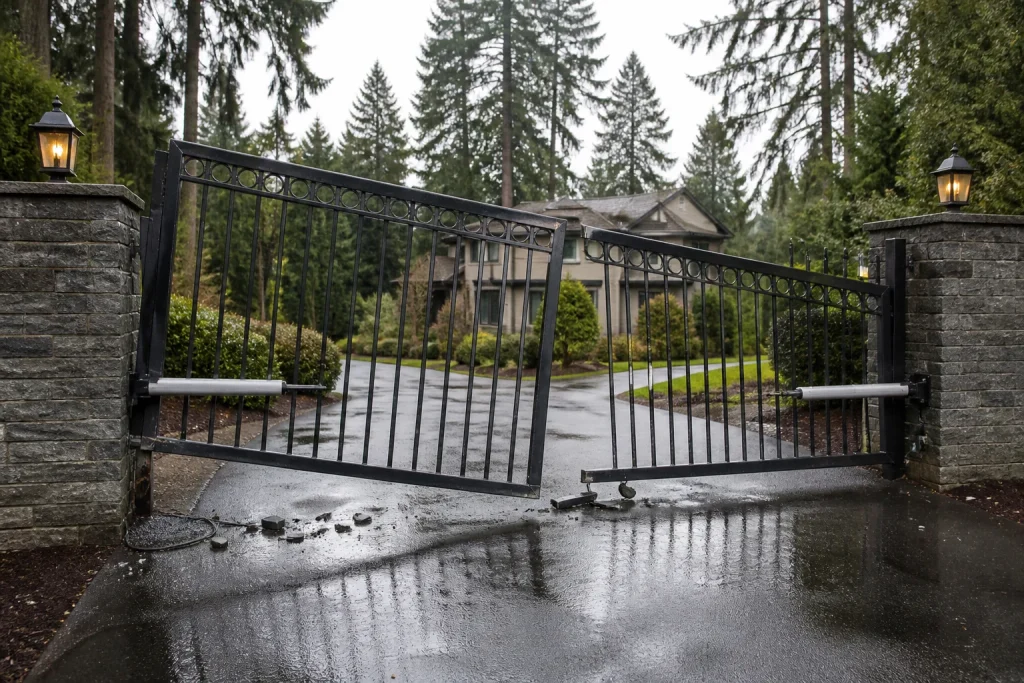
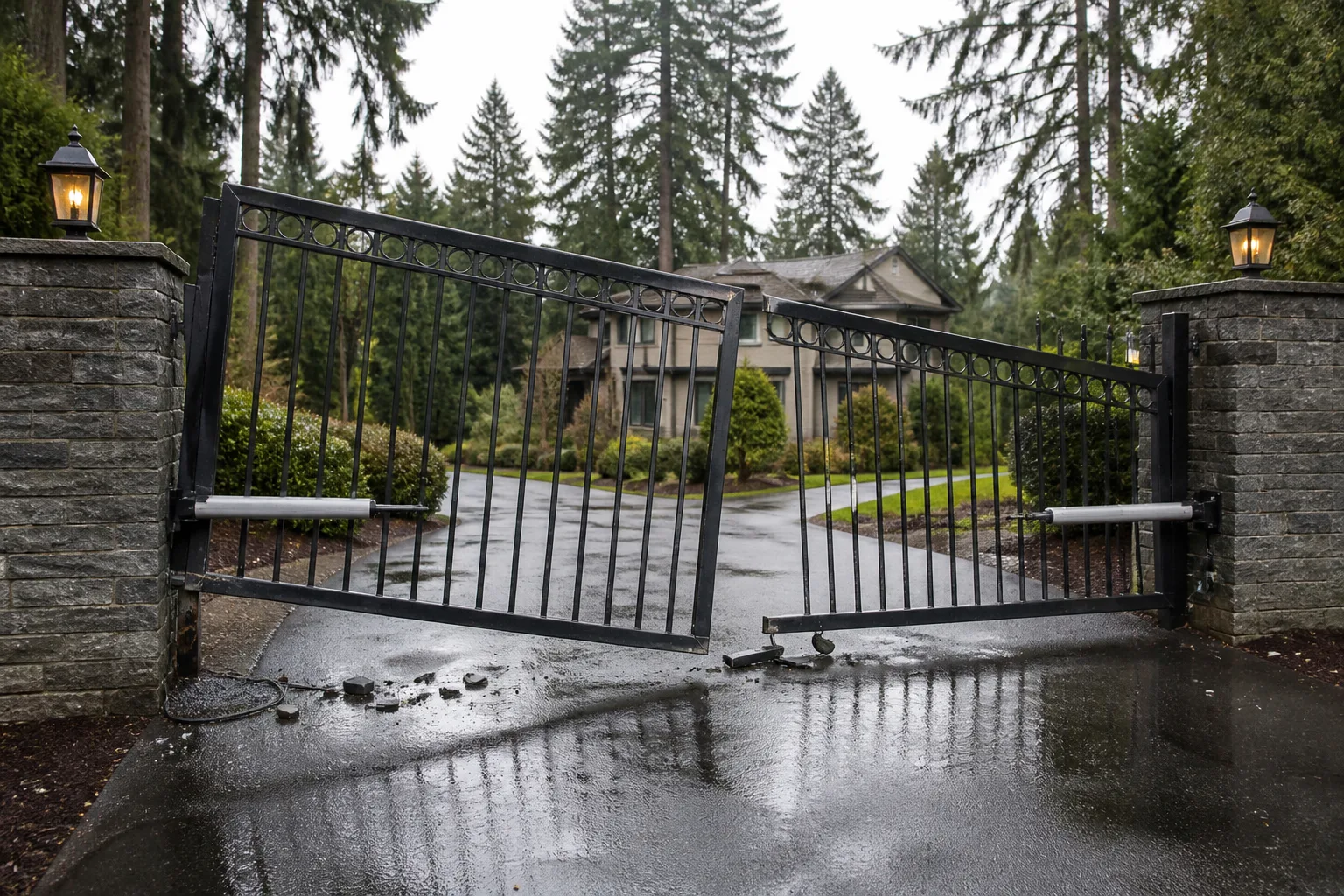
- The gate is off its track or hanging. Don’t try to lift a heavy gate panel by hand – it can crush fingers or worse.
- You smell burning from the control box or see a tripped breaker that won’t reset. Stop and call. That’s electrical, and it’s not a homeowner fix.
Automated gate repair is its own specialty, and it’s all we do. A gate panel that weighs more than two people can safely hold, combined with live wiring to an operator, is exactly the kind of job to leave to a trained technician. Our gate installation team handles new systems too if a repair isn’t the right answer.
What Do After-Hours Gate Calls Really Look Like in Bellevue?
Honest answer: it depends on what’s wrong. The phone line is answered 24/7, and we schedule dispatch from 7am to 7pm, Sunday through Friday. We’re closed Saturday. If your gate fails outside dispatch hours, we book you into the next opening – which for most Bellevue-area calls means the next morning.
But that’s rarely as bad as it sounds. Because most gate emergencies turn out to be the simple electrical or release issues we covered at the top, many homeowners solve the problem themselves before a technician ever needs to come out. And when a call does go out, having your symptoms ready means the technician shows up prepared to fix it, not to diagnose it from scratch. We answer 24/7. A call outside dispatch hours is booked into the next opening, Sunday through Friday, 7am to 7pm. Setting that expectation up front beats promising a middle-of-the-night heroics story.
Key Takeaways
- Check the manual release, breaker, and backup battery before you call anyone.
- Triage in under two minutes by listening to your operator: silent means electrical, humming means mechanical, erratic means operator failure.
- A stuck-open gate is the more urgent security situation than a stuck-closed one.
- Tell the dispatcher specific symptoms, not “it just stopped working.”
- Automated gate repair is a specialty – bring in a technician for anything electrical, heavy, or off-track.
The Bottom Line
Most “my gate is stuck” emergencies in Bellevue resolve with a manual release or a tripped breaker, and you can check both in about five minutes. The real emergencies – electrical faults, gates off their track, operators behaving erratically – need a specialist who knows the systems. If you’re in Bellevue and need help, Bellevue Gate Repair offers free estimates. Call (855) 683-9015. We answer 24/7, with fast dispatch from 7am to 7pm, Sunday through Friday.
Frequently Asked Questions
Most stuck-closed gates trace back to a bumped manual release, a tripped breaker, or a dead backup battery. Check those three first. If your gate still won’t open, it’s an operator or mechanical fault that needs a technician. Call (855) 683-9015 for a free estimate.
Often yes, if the call comes in during dispatch hours. Same-day service is available for many gate and operator faults in Bellevue and surrounding areas. Call (855) 683-9015 to schedule. We answer 24/7, and dispatch runs 7am to 7pm, Sunday through Friday.
Locate the release key or lever on the operator housing and disengage it slowly with the power off. Push the gate gently by hand to confirm it moves. Don’t force a stuck release – that can bend the drive gear. If it won’t release, call a specialist.
Block the opening with a vehicle or temporary barrier, alert anyone sharing the property, and leave the operator alone. Don’t keep cycling it – that can burn out the motor. Call (855) 683-9015 to book a repair for the next dispatch window.
Written by the team at Bellevue Gate Repair.
Need Gate Repair Help?
Call Bellevue Gate Repair - licensed & insured, here with fast help in Bellevue.
(855) 683-9015