
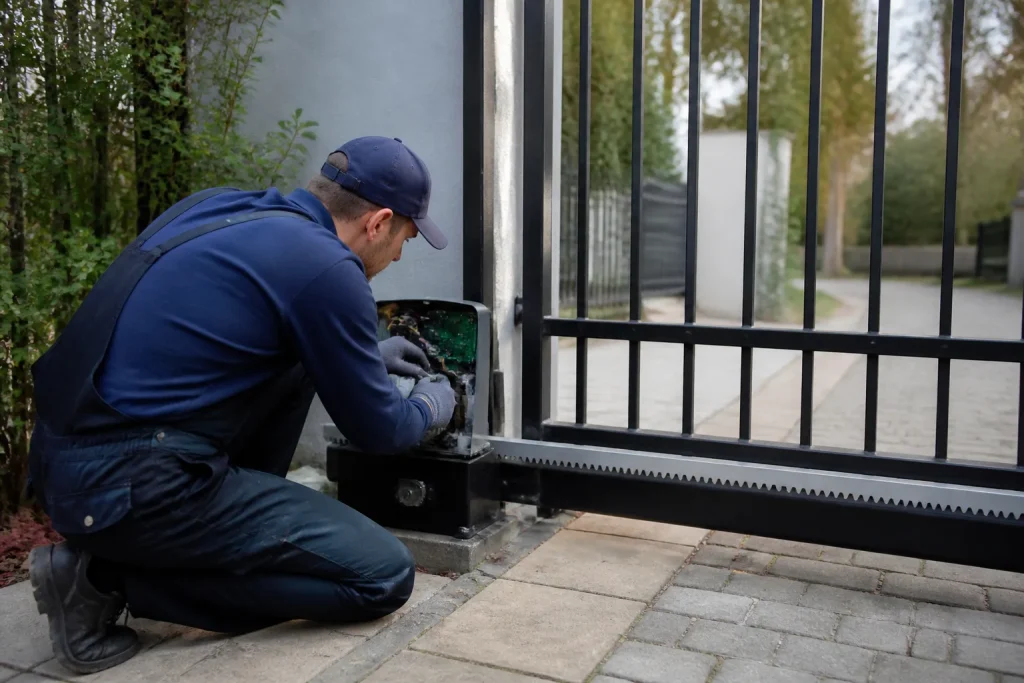
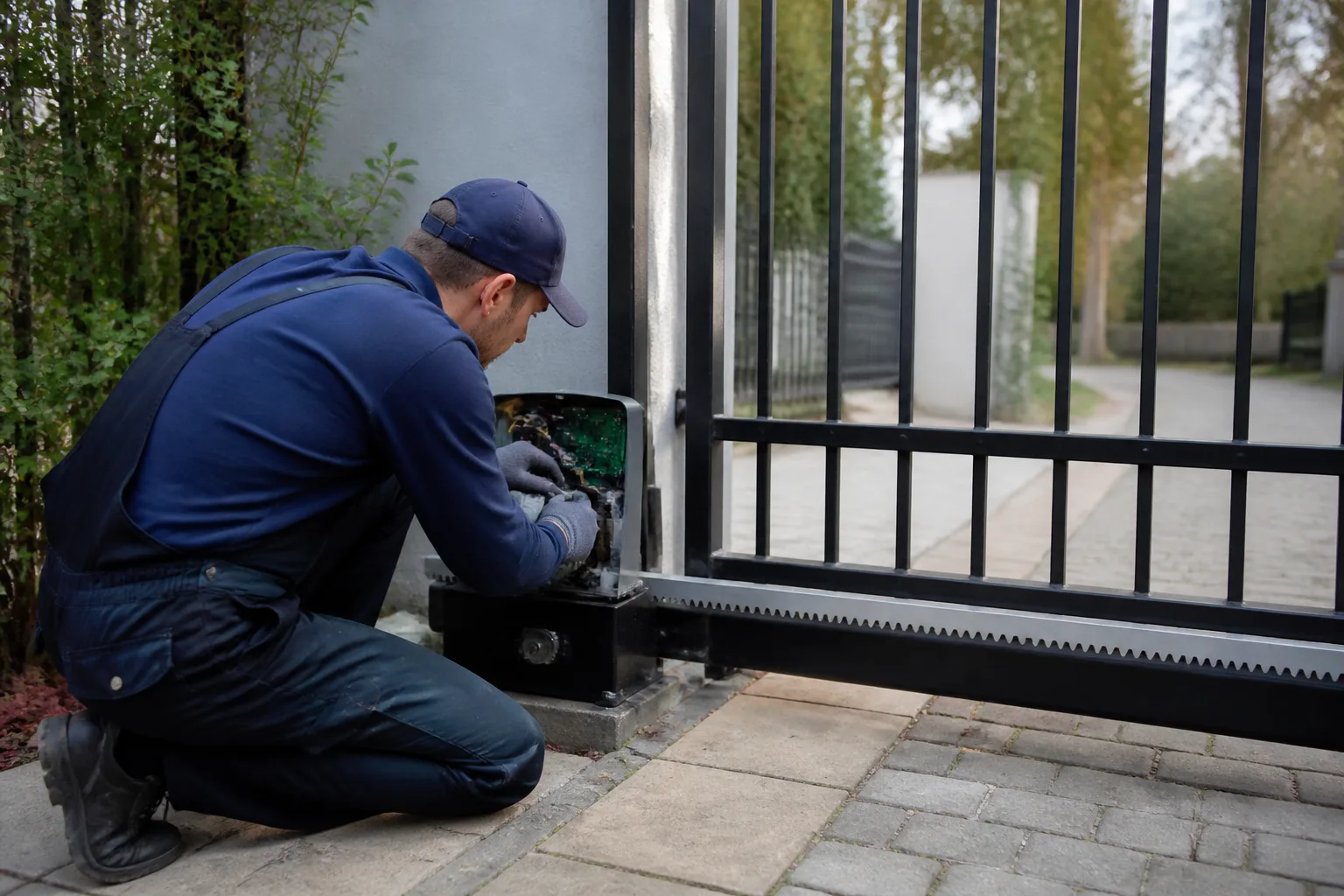
FAAC Gate Repair in Bellevue: A Homeowner’s Guide
A FAAC gate that stops working almost never has a worn-out motor. Most of the time the operator itself is fine, and the real fault sits in the control board programming, a low or contaminated hydraulic fluid reservoir, or an accessory like a photocell or loop detector that has drifted out of spec. If you’d rather not spend an afternoon with a multimeter and a translated manual, call (855) 683-9015 and we’ll get a FAAC specialist on-site.
Why FAAC Operators Fail Differently Than Other Brands
FAAC builds its operators for Italian infrastructure: busy commercial entrances, high cycle counts, decades of daily use. That engineering shows up in the parts, and it shows up in the failure pattern too. A cheap actuator tends to grind itself down and die loudly. A FAAC unit usually keeps its mechanicals intact and misbehaves electronically instead.
What we typically find on a FAAC call in Bellevue comes down to a few categories:
- Programming drift. The board has lost its travel limits, its slowdown points, or its decoding settings, so the gate reverses, stops short, or refuses to close.
- Accessory faults. A dirty photocell, a failed safety edge, or a loop detector that’s out of tune tells the board the gate should stay put. The board complies.
- Hydraulic trouble. Underground and above-ground hydraulic operators lose fluid, take on moisture, or develop a pump fault that looks electrical but isn’t.
- Power and wiring. A tripped breaker, a corroded connection, or a control board that took a surge.
The useful part of that list: nearly every item on it is diagnosable before anything gets replaced. That’s the difference between a repair and an unnecessary new operator, and it’s why we approach a FAAC call as an electric gate repair problem first and a parts problem second.
Hydraulic vs. Electromechanical FAAC: Two Different Failure Modes
FAAC makes both, and they don’t break the same way. Knowing which one you have tells you a lot about what to expect.
Hydraulic underground and above-ground operators
These use a pump and fluid to move the gate. The most common failure here is fluid contamination. In a Bellevue driveway, rain and ground moisture work their way past aging seals, and the hydraulic fluid picks up water. The result is emulsification: the fluid turns milky, loses its lubricating and load-bearing properties, and the gate starts moving slowly, juddering, or stalling mid-travel.
Here’s the part that matters for your wallet. A failed pump and an emulsified fluid reservoir both make the gate sluggish, but they need completely different responses. A technician who reads the symptom as “bad pump” replaces an expensive component when a fluid service was the actual fix. Confirming fluid condition before condemning the pump is basic FAAC practice, and it’s the first thing we check.
Electromechanical operators
These fail electrically. You’ll see control board faults, limit switch issues, capacitor failures, and programming that no longer matches the gate’s physical travel. The mechanical arm and gearbox usually outlive the electronics by a wide margin, which is why diagnosis on these models is board work, not motor work.
How to Read FAAC Control Board Diagnostics
FAAC boards do talk to you, if you know what the lights mean. The 452MPS and the 844 series are the boards we see most often on residential FAAC installs around Bellevue, and both use onboard LEDs to report status and faults. The catch is that the documentation ships in Italian, and a direct translation of “errore” doesn’t tell you which accessory is actually misbehaving.
What the LEDs are good for, in general terms:
- Power and status indicators confirm the board is alive and receiving correct supply voltage. If these are dark, stop and check the feed before anything else.
- Input indicators show the state of connected accessories: stop buttons, safety edges, photocells, and open/close commands. An input LED that’s sitting in the wrong state usually points straight at a failed or misaligned accessory.
- Fault and error patterns flag specific conditions like an obstruction, a limit error, or a motor fault. Reading them correctly is what separates a ten-minute diagnosis from a parts lottery.
If the board itself tests fine, the next step is often related: electrical gate repair work on the operator wiring, the power run, and the accessories that feed those inputs. We do both in a single visit because on FAAC systems they’re nearly always the same conversation.
Why Bellevue’s Wet Weather Is Hard on FAAC Hydraulics
Bellevue gets real rain, and it gets it for months at a stretch. Underground hydraulic operators sit in that environment year after year. Seals that would last a decade in a dry climate can start letting moisture in sooner here, and once water is inside the reservoir, the clock is running.
Signs that fluid is the problem rather than the pump:
- The gate moves, but slower than it used to, especially in cool weather.
- Movement is jerky or uneven through part of the travel.
- The operator sounds strained without any obvious mechanical binding.
- Fluid drained from the reservoir looks milky or cloudy instead of clear.
An emulsified reservoir is a fluid service. A pump that can’t build pressure despite clean fluid is a pump problem. Getting that call right the first time is most of the battle, and it’s the kind of thing a technician who works on FAAC regularly can identify quickly. Our technicians have up to experience, and the FAAC hydraulic line comes up often enough in the Bellevue area that the pattern is familiar.
FAAC Parts: What’s on Hand and What Takes Time
Not every FAAC part is a stock item, and pretending otherwise sets up a bad experience. Here’s the honest breakdown.
- Common wear and service items – photocells, safety edges, batteries for backup systems, hydraulic fluid, and standard electrical components – are the kind of thing a dedicated gate shop keeps on hand or sources quickly.
- Control boards and model-specific electronics can need a lead time depending on the exact FAAC model and revision. Board revisions matter, and a mismatched board wastes everyone’s day.
- Hydraulic pumps and motor units for less common models are the long-lead items. If one of those is genuinely required, you want to know early.
That split shapes your urgency decision. If the fix is a fluid service or a photocell, it’s a straightforward repair. If it’s a board or pump lead time, it may be worth asking whether the gate can be put into a safe manual state in the meantime, and whether a temporary access arrangement makes sense for your household or property. A repair company that can tell you which category you’re in on the first visit is doing its job. One that promises a same-day part for everything isn’t.
When to Call a Pro (and What to Ask First)
FAAC repairs involve line voltage, control board logic, and heavy moving panels. A gate operator stores energy, and a gate in motion can crush. We don’t recommend homeowners open the control enclosure or reach into the operator. Visual checks only: is the gate path clear, is anything visibly damaged, does the manual release work as designed. Everything past that belongs to a trained technician.
Since plenty of companies claim FAAC experience, here are questions worth asking before you book:
- “Which FAAC boards do you work on most?” A real FAAC shop will name the 452MPS or the 844 without hesitating.
- “How do you tell emulsified hydraulic fluid from a failed pump?” Vague answers here are a red flag.
- “Can you read the fault codes on the board?” If the answer is no, you’re paying for guesswork.
- “Do you service both the mechanical gate and the electrical side?” You want one visit, not two contractors pointing at each other.
- “Are you a gate specialist or is this a side service?” A company that works on LiftMaster, Elite, and Mighty Mule systems alongside FAAC is fluent across the trade. A company that treats gates as an add-on is not.
That last question is the one that matters most. FAAC systems reward specialists and punish generalists.
Related services in Bellevue: if your FAAC gate needs attention, we handle Bellevue gate repair across repair, automation, and installation.
The Bottom Line
If your FAAC gate has stopped cooperating, the operator is probably not the culprit. Think control board programming, hydraulic fluid condition, and accessory faults first. Read the board diagnostics, check the fluid before condemning the pump, and know which parts are quick versus long-lead so you can make a sensible call about urgency. And pick a repair company that actually works on FAAC boards and hydraulics, because the difference shows up in the diagnosis.
If you’re in Bellevue and need help, Bellevue Gate Repair offers free estimates and a written price agreed before any work starts. Call (855) 683-9015. We answer 24/7. Fast dispatch from 7am to 7pm, Sunday through Friday.
Frequently Asked Questions
My FAAC gate opens but won’t close. What’s usually wrong?
An accessory is telling the board not to close. The usual suspects are a misaligned or dirty photocell, a failed safety edge, or a loop detector out of tune. It’s rarely the motor. Call (855) 683-9015 for a diagnosis, free estimate included.
How do I know if my FAAC hydraulic fluid has gone bad?
It turns milky or cloudy instead of clear, and the gate often moves slowly or unevenly. That’s emulsification from moisture getting past the seals, which is common in Bellevue’s wet climate. A fluid service fixes it if the pump is still sound. Call us for an on-site check.
Can you repair a FAAC control board, or does it always need replacing?
It depends on what’s actually failed. Many FAAC issues trace to a connected accessory, a wiring fault, or lost programming rather than the board itself. Diagnosing before replacing is the whole point. Call (855) 683-9015 and we’ll tell you what you’re dealing with.
Do you work on other gate brands besides FAAC?
Yes. We’re experienced with FAAC, LiftMaster, Elite, and Mighty Mule systems, among others, and we work on both the mechanical gate and its electrical components. Gates are all we do. Estimates are free – call (855) 683-9015.
Written by the team at Bellevue Gate Repair.
Need Gate Repair Help?
Call Bellevue Gate Repair - licensed & insured, here with fast help in Bellevue.
(855) 683-9015